Top 15 ETL Tools (for 2026)



Introduction
The data integration market is expected to grow from USD 17.58 billion in 2025 to USD 33.24 billion by 2030, at a CAGR of 13.6%. This rise is driven by increasingly complex data environments and hybrid infrastructures that demand scalable, reliable integration. As a result, many organizations are moving away from legacy ETL systems toward cloud-native platforms with low-code API capabilities.
At the same time, AI adoption has accelerated across industries. The global AI market, valued at USD 390.91 billion in 2025, is projected to reach USD 3,497.26 billion by 2033, growing at a CAGR of 30.6%. AI is now embedded in analytics and operational decision-making.
ETL (Extract, Transform, Load) remains a widely used integration method, and AI-enabled features have become a key differentiator in modern tools. While many offerings are still evolving, AI-driven workflow optimization is gaining attention. However, AI alone should not determine an ETL tool’s effectiveness. In our list of the Top 15 ETL tools for 2026, we evaluate platforms across multiple criteria to help teams choose the tool that takes care of the basics first, i.e., ensuring dependable, timely access to insights.
Evaluation Criteria for choosing top ETL tools
When evaluating the top ETL tools for 2025, we have considered a variety of metrics such as
- ease of use (especially with no-code platforms),
- scalability to handle growing data volumes,
- cost-effectiveness,
- The array of data connectors provided
- Another vital aspect is their G2 rating (which reflects real-world user satisfaction and market presence).
- AI enablement/ integration
Based on our evaluation criteria, have a look at our list of ‘top 15 ETL Tools for 2026.’
- DataChannel
- Fivetran
- Airbyte
- Stitch
- Funnel
- Portable
- Talend
- Informatica PowerCenter
- Oracle Data Integrator
- Integrate
- Meltano
- Matillion
- Apache Airflow
- Azure Data Factory
- Qlik Compose
1. DataChannel
ETL & Reverse ETL
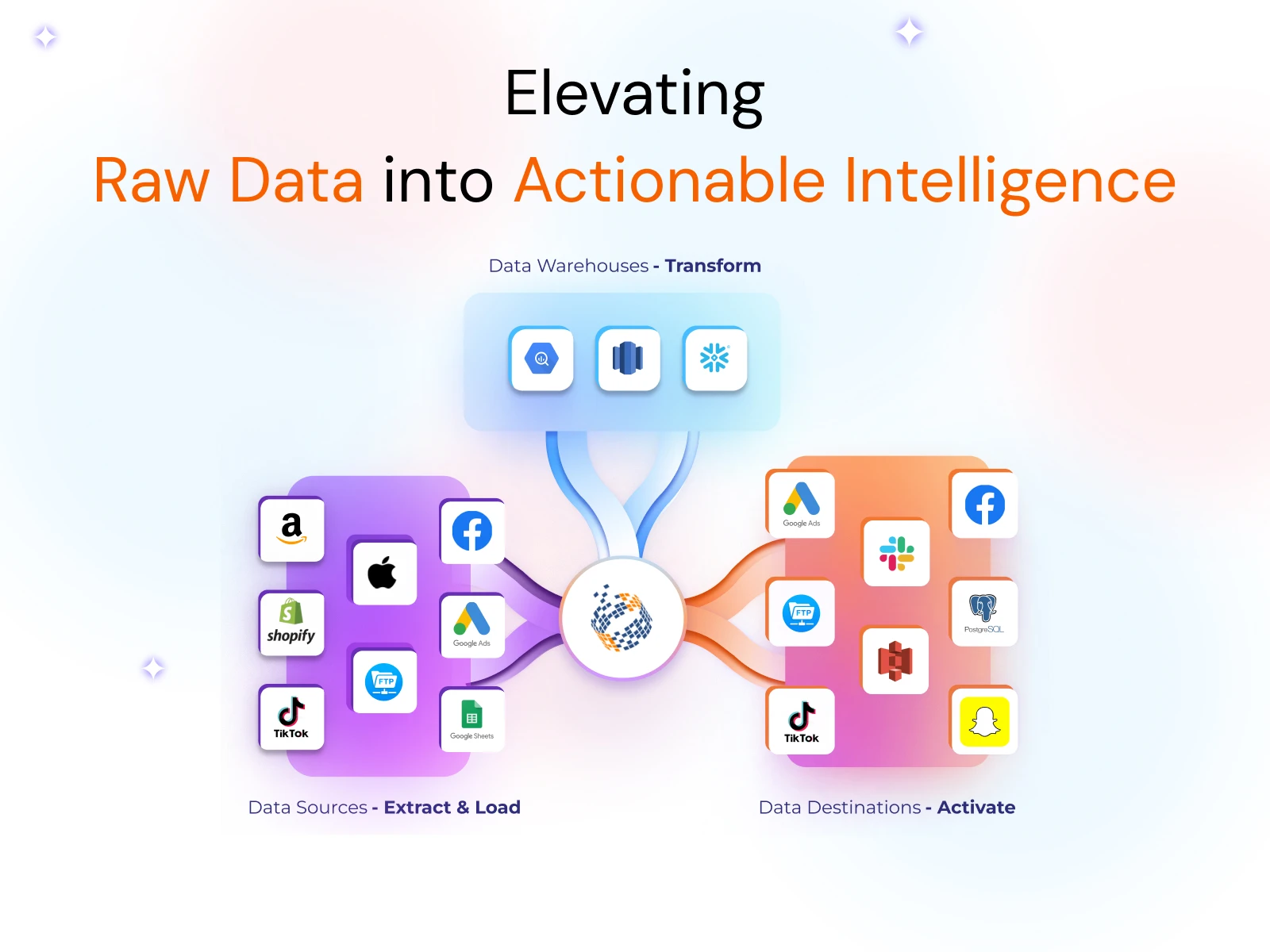
DataChannel is one of the very few no-code platforms that offers multiple functionalities, the highlights being both ETL & Reverse ETL. Users can integrate and operationalize their data from various sources without writing a single line of code.
Traditional ETL data integration demands significant engineering effort — from building connectors to managing schema changes and scheduling batch jobs. These manual processes slow teams down and increase time to value.
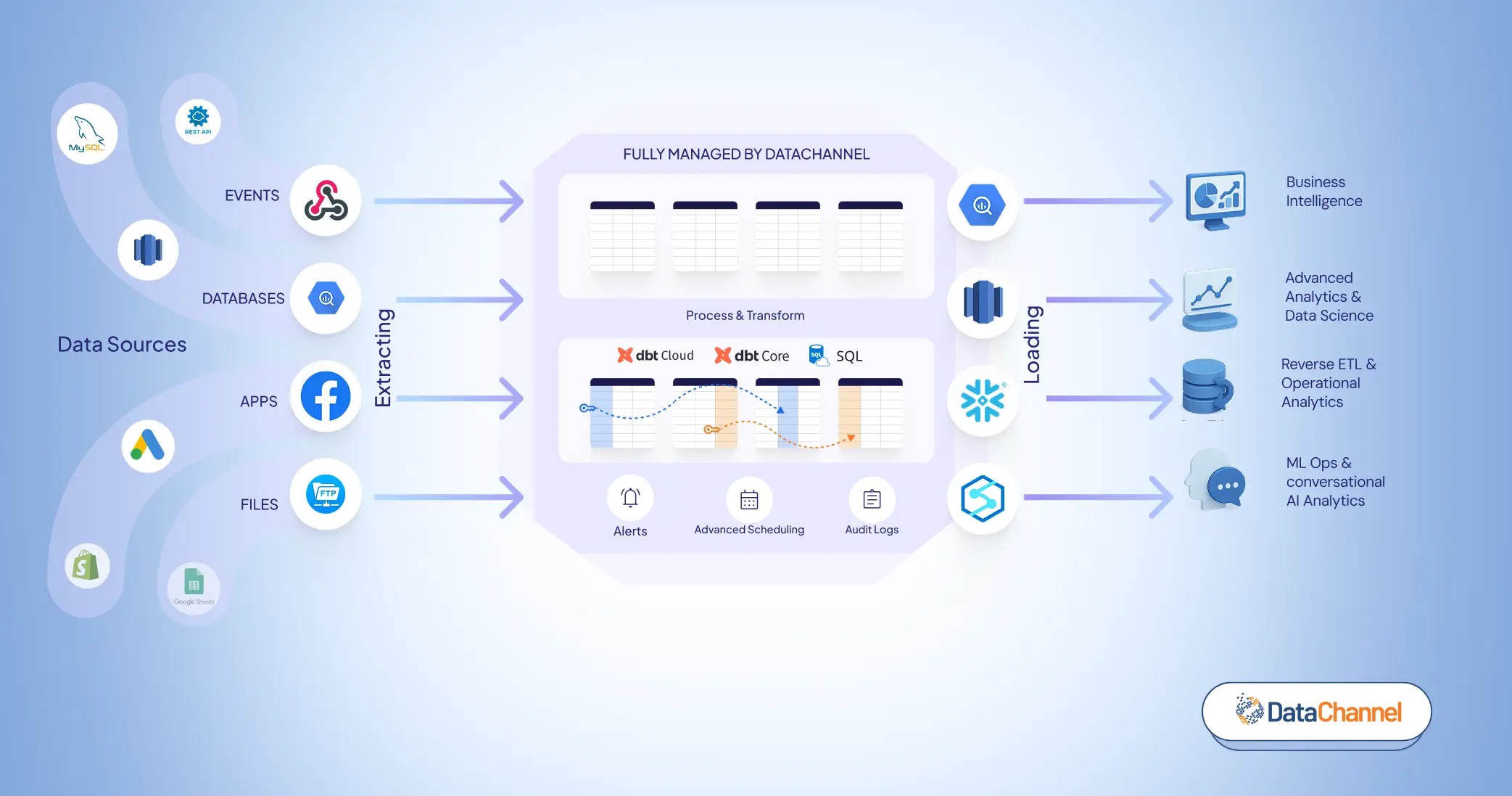
DataChannel offers 125+ integrations, and it literally automates the hardest parts of ETL: connector maintenance, schema drift handling, and ingestion from hundreds of sources. Moreover, it offers built-in transformations (via both dbt & SQL data models) and support for near real-time data movement. DataChannel helps you access up-to-date data with minimal manual effort.
Not only data integration (ETL), but DataChannel also caters to your data activation (Reverse ETL) requirements, basically a tool that works well for both data and marketing teams. Reverse ETL serves multiple business use cases, such as running hyper-personalized email marketing campaigns, identifying upselling and cross-selling opportunities based on first-party data on customer interactions.
Management API & Workspaces
In line with some of its biggest competitors, DataChannel in 2024 also launched its very own Management API, allowing data engineers/ developers to programmatically move data from their desired data source to the destination without having to interact with DataChannel’s web interface.
To further enhance support for Agency clients, DataChannel also developed “DataChannel workspaces.” These workspaces enable our enterprise clients, especially marketing agencies, to create and manage multiple workspaces within a single account. This eliminates the need for logging into separate accounts for each client and allows for a hierarchical structure of role-based access, including Super Admin, Admin, and User levels.
Data Orchestration
“Data Orchestration with DataChannel” was also rolled out in early 2024, allowing users to build end-to-end workflows. Our Data orchestration feature aims to serve different requirements for our users instead of relying on a stack of multiple tools. Starting with data extraction, transformation to loading, activation, and visualization, DataChannel integrates and interconnects your workflows in a way in a sequential manner such that the next step is executed only after a successful preceding step (while delivering fresh data at every step).
AI-Powered Analytics with Neo
Neo, our AI-powered conversational data analyst, empowers you to build dashboards and insights out of your data within seconds. You can ask questions about your datasets in plain English, and ‘neo’ will answer them & provide you with interactive graphs and tables based on your data.
In simple words, you can converse with Neo like a data analyst; it takes care of the entire planning & coding, choosing the right fields from your tables required for visualization. All of this is directly on top of your data warehouse with a natural language interface and without requiring a single line of code.
On the cost front, DataChannel remains a customer’s favorite for small businesses and large organizations alike because of its very competitive price packages. This tool offers serious bang for the buck, embodying the true essence of cost-effective data integration.
G2 Rating: 4.8/ 5
Comparatively, DataChannel's G2 rating stands firmly among the best ETL tools. It's recognized for its user-friendly interface, fantastic customer service, and excellent platform functionality.
2. Fivetran

Fivetran, a cloud-native ETL (Extract, Transform, Load) tool, is taking data integration to a new analytical level. The tool comes packed with a rich arsenal of over 150 data connectors, enabling plugging and playing data sources with unique simplicity and agility to match the evolving data landscape. Fivetran tops the chart for its robust automation capability. Not only can it connect to your data sources, but it can also detect schema changes and handle adjustments automatically.
Fivetran, in 2025, acquired Census and agreed to merge with dbt Labs to provide a unified offering under one tool by bridging together ingestion, transformation, and activation. This covers most of a typical data lifecycle and reduces the need for stitching multiple vendors together.
G2 Ratings: 4.3/ 5
Its G2 rating is consistently high, reflecting positive user experiences and the tool's efficiency in handling complex data operations.
3. Airbyte

Airbyte is a partially open-source data integration platform offering a simple yet flexible solution for your data pipeline needs. Its comprehensive collection of pre-built data connectors allows seamless integration with different data sources, significantly reducing the time and effort typically required for extraction, transformation, and loading processes. Moreover, Airbyte also provides a no-code interface, making data extraction simple for non-technical users, but at the same time not limiting the power users who want to write custom logic.
Airbyte 2.0
Airbyte 2.0 marks a shift from a connector-centric tool to a full data movement and activation platform designed around enterprise requirements and AI workflows. It now also supports pushing data from the warehouse into operational systems such as Salesforce, HubSpot, or Customer.io, instead of just into dashboards.
G2 Ratings: 4.4/ 5
Despite tough competition from established players like Informatica and Stitch, Airbyte ranks highly in terms of ease of use and implementation, offering a more user-friendly and cost-effective solution.
4. Stitch

Stitch caters to businesses that connect to various data sources, automate data flows, and streamline data integration. Its signature ‘No-code’ platform offers data connectors to popular databases and SaaS platforms.
Key features of Stitch include
- Simple and swift data replication
- Wide range of pre-built integrations
- High scalability
- Secure data pipeline & seamless integration with popular data warehouses
- Focus on stable, batch-based ETL with incremental improvements to connector performance, schema handling, and sync reliability rather than introducing major architectural shifts.
G2 ratings: 4.4/ 5
On G2, the leading destination for product discovery and reviews, Stitch holds a strong rating, reflecting its consistent performance and user satisfaction.
5. Funnel

Funnel is a SaaS-based, no-code ETL tool that helps you extract data from over 500 sources, transforming it according to user needs, and loading it into the user's preferred data warehouse, data visualization tool, or BI solution. This tool covers all the bases.
Key features
- Custom Data Transformations: You can adjust, clean, and classify your data in Funnel easily.
- Data Connectors: Funnel can connect, collect, and integrate data from various sources like digital marketing platforms, CRM systems, and more.
- Data Export Capabilities: Extracted data can be loaded to almost any data destination like Google Data Studio, Tableau, Power BI, and more.
- Funnel Marketing Intelligence: Funnel Marketing Intelligence is the first end-to-end solution built for marketers and data teams alike. It’s easy enough for marketers of all stripes to use and powerful enough for sophisticated data teams at brands like Home Depot and Publicis.
- In 2025, Funnel.io focused on strengthening its core as a marketing data hub by expanding ad platform connectors further, improving automation in account syncing, and making Snowflake integration fully GA.
G2 ratings: 4.5/ 5
When compared to other tools, Funnel excels in data integration and customization, making it a top player among ETL tools. While other tools might be better at certain complex data architectures, Funnel keeps it simple and effective.
6. Portable

Portable is a no-code ETL solution that helps analytics teams efficiently move data from multiple systems into their data warehouse. It combines the best of both software and service by providing a mix of pre-configured connectors and custom ETL solutions designed to meet the unique requirements of data teams.
G2 Ratings
Portable enjoys an average of 4.9 out of 5 stars on G2 and provides hands-on customer support, custom development, etc.
Portable Key Features
- Portable is known for its quick development of custom connectors, turning integration requests into fully functional solutions in a matter of hours, or even minutes.
- With a fixed pricing model for API-to-warehouse connectors, teams can focus on extracting valuable insights from their data without worrying about fluctuating usage costs.
- Portable’s recent focus has been on connector breadth, fast custom integrations, hands-on support, and reliable ETL pipelines into analytics stores.
7. Talend

Talend provides a comprehensive set of ETL data integration tools designed to work seamlessly with both on-premises and cloud-based data sources. Its platform includes a wide range of pre-built connectors, making it easier to integrate diverse systems.
G2 Rating
Talend Data Integration has received an average rating of 4.3 out of 5 stars on G2 and was also ranked for its fast implementation in the winter of 2024 as a top tool.
Talend Key Features:
- Talend's Data Integration platform enables the efficient and precise implementation of large-scale data structures.
- The platform helps users uphold data quality through features such as data profiling, cleansing, and duplicate reduction.
- With robust tools for tagging, tracking, and monitoring, Talend also supports effective data governance practices.
- The platform also includes scheduling capabilities, allowing users to automate and streamline their data integration workflows.
8. Informatica PowerCenter
Informatica PowerCenter is a robust data integration platform designed for enterprise-level ETL tasks. It is part of the broader Informatica suite of cloud-based data management tools. PowerCenter is known for its strong performance and compatibility with a wide variety of data sources, including both SQL and non-SQL databases.
Intelligent Data Management Cloud
The Informatica Intelligent Data Management Cloud™ (IDMC) is designed to help businesses efficiently handle the complex challenges of dispersed and fragmented data. This is the industry’s first and most comprehensive cloud-native, AI-powered, end-to-end data management cloud, empowering organizations to reimagine and redefine how they manage and innovate with their data.
G2 Rating
Informatica PowerCenter earned an average of 4.3 out of 5 stars on G2 and was named one of the website's top 50 IT infrastructure products in 2024.
Informatica Key Features:
- The platform simplifies and accelerates the ETL process by automating data movement between systems.
- It also prioritizes data security through features such as encryption, user access controls, and other protective measures.
- PowerCenter supports advanced analytics by incorporating predictive models, machine learning capabilities, and other tools to help users uncover meaningful insights from their data.
9. Oracle Data Integrator
Oracle Data Integrator (ODI) is a versatile data integration tool that integrates seamlessly within Oracle's data management ecosystem. It is particularly well-suited for organizations already utilizing Oracle applications like Oracle E-Business Suite (EBS).
ODI is available in both on-premises and cloud-based versions, with the cloud offering known as Oracle Data Integration Platform Cloud, providing flexibility to meet various deployment needs.
Oracle AI
Using Oracle AI, you can access proprietary or open-source generative LLMs as suited for your needs, and go on to use generative AI as managed services for your custom applications, with the data already in Oracle’s data platform or integrated within Oracle Cloud Applications.
G2 Rating
Oracle Data Integrator has an average rating of 4 out of 5 stars on G2.
Key Features
- Equipped with advanced tools for complex data transformation.
- Compatible with Hadoop and NoSQL databases to support diverse data environments.
- Features a robust scheduling engine to streamline and automate integration workflows.
- Available as a cloud-based solution via Oracle Data Integration Platform Cloud for added flexibility.
10. Integrate.io
Integrate.io is a low-code data integration platform designed to simplify ETL processes, API creation, and data analysis. It offers a wide range of features that allow users to efficiently build and manage secure, automated data pipelines, positioning it as a popular choice among ETL tools.
G2 Rating
Integrate.io enjoys a G2 rating of 4.3 out of 5 on G2.
Key Features
- Supports more than 100 leading SaaS applications and data repositories, offering compatibility with a wide variety of data sources.
- Allows customization of the data integration process using an advanced expression language, robust API capabilities, and webhooks.
- Features a Field Level Encryption layer for securing individual data fields with unique encryption keys, ensuring data protection and compliance.
11. Meltano
Meltano is an Extract & Load tool with an open source DataOps infrastructure built specially for data engineers. It offers a plugin-based architecture, basically a much-needed glue between best-in-class open source data tools and technologies. Meltano has become a full-fledged open source ELT solution because of the first set of plugins that the tool now supports: Singer taps and targets for integration, dbt for transformation, and Airflow for orchestration.
Key Features:
Meltano is a flexible tool that aims to fit into your existing stack rather than trying to replace it.
- Singer-based ELT framework (extensible taps & targets, open standard)
- Git-native, YAML-driven configuration (code-first pipelines, version control)
- Flexible orchestration support (built-in scheduler, Airflow, Dagster, cron)
- Native dbt integration (end-to-end ELT + transformation management)
G2 Rating:
Meltano has a G2 rating of 4.9/5 based on 7 reviews
12. Matillion

Matillion is built on the core concept of the Data Productivity Cloud, a unified platform that combines data integration, orchestration, and governance for modern enterprises. Within the Data Productivity Cloud, Matillion’s newly developed agentic data team, Maia, focuses on autonomously accelerating data pipelines (keeping data secure within your cloud) while eliminating repetitive engineering work.
Key Features:
- Unified platform for data ingestion, transformation, orchestration, and governance
- Agentic automation through Maia, Matillion’s autonomous data team
- Secure pushdown ELT architecture — defers transformations until data is loaded into the cloud platform
G2 Rating:
Matillion enjoys a decent G2 rating of 4.4/5
13. Apache Airflow
Both ETL and ELT data pipelines are the most common use cases for Apache Airflow. 90% of respondents in the 2023 Apache Airflow survey are using Airflow for ETL/ELT to power analytics use cases.
Using Airflow for ETL/ELT pipelines:
- Tool agnostic: can be used to orchestrate ETL/ELT pipelines for any data source or destination.
- Extensible: users can write their own custom operators and hooks for specific use cases.
- Dynamic: these dynamic tasks serve as placeholders to adapt at runtime based on changing input.
- Scalable: can be scaled to handle an infinite number of tasks and workflows, given enough computing power
G2 Rating:
Apache Airflow (one of the user’s most favorite tools) has a rating of 4.4/5 on G2
14. Azure Data Factory
Azure Data Factory is a fully managed and serverless data integration service. Users can visually integrate data sources with built-in, maintenance-free connectors to easily construct extract, transform, and load (ETL) and extract, load, and transform (ELT) processes in a code-free or code-based manner.
Key Features:
- Visual pipeline builder (GUI-first) with drag-and-drop data flows
- Hybrid data movement (on-prem + cloud via Integration Runtime)
- Native Azure ecosystem integration (Synapse, Data Lake, SQL DB, Power BI)
- Pipeline orchestration & scheduling (triggers, event-based runs, dependency management)
- Monitoring & observability dashboard (run history, alerts, activity-level logging)
G2 Rating:
Microsoft’s Azure Data Factory has a rating of 4.6/5 on G2
15. Qlik Compose
Qlik Compose is an agile data warehouse automation solution that enables enterprises to streamline data warehousing design, development, and rollout. Qlik Compose automatically generates ETL code, quickly applying updates, leveraging best practices, and using proven design patterns.
Key Features:
- Automate end-to-end workflow generation from data ingest to report generation
- Automate data model design and source mapping. Data models can be created or imported, then modified and enhanced iteratively.
- Optimize the data warehousing process with Workflow Designer and Scheduler
G2 Rating:
A fairly new tool, Qlik Compose, enjoys a decent G2 rating of 4.5/5 based on 4 reviews
Recommendation for the best ETL tool based on the evaluation metrics
Choosing the right ETL tool depends on your business goals and overall data integration approach. DataChannel stands out for its versatility and cost efficiency, making it a strong fit for teams that want broad capabilities without heavy overhead. If your use case involves advanced or highly customized transformations, Informatica remains a solid choice. For startups and smaller teams prioritizing affordability with room to grow, Stitch offers a practical balance of simplicity and scalability.
Looking ahead, ETL tools are set to evolve alongside rising data volumes and increasingly complex ecosystems. The growing convergence of ETL and reverse ETL signals a shift toward more connected, two-way data flows, where insights move seamlessly between analytical and operational systems. As businesses place greater emphasis on timely, reliable data delivery, ETL tools will continue to play a central role in how modern organizations operate and make decisions.
FAQs
- What’s the difference between ETL and ELT in modern data stacks?
ETL transforms data before loading it into the destination, while ELT loads raw data first and transforms it inside the warehouse. Most modern ETL tools like DataChannel perform data integration using the ELT process (unlike legacy ETL tools).
- Which ETL tools support reverse ETL in 2026?
Several ETL platforms now support reverse ETL, also known as data activation. Fivetran, DataChannel, and Airbyte allow teams to sync warehouse data back into CRMs, marketing tools, and support systems.
- What features matter most in ETL tools in 2026?
Key features include automated schema change handling, data observability, strong connector ecosystems, and role-based access controls.
- How is AI being used in ETL tools today?
AI is mainly used for conversational analytics, schema mapping suggestions, and pipeline monitoring. It supports reliability rather than replacing human-defined pipelines.


Try DataChannel Free for 14 days
